


3RD EDITION
After a first edition launched in 2020 under the unique circumstances of the Covid pandemic, followed by a particularly demanding second edition in 2022, the Vendée Arctique continues to grow in stature.
This third edition marks a new milestone with a completely open course, the crossing of the Arctic Circle, and the official opening of the qualification cycle for the 2028 Vendée Globe.
9 SKIPPERS READY FOR THE START
Nine skippers will set sail from Les Sables d’Olonne on 7 June for this solo, non-stop, unassisted adventure.
The fleet may be deliberately compact, but it is packed with talent and potential, bringing together a wide range of profiles: experienced sailors, IMOCA newcomers, solo racing specialists, Olympic sailors and leading figures from crewed offshore racing.
Among them are several declared contenders for the 2028 Vendée Globe, as well as skippers who will be discovering the high latitudes aboard an IMOCA for the very first time.
The 2026 fleet:
- Ambrogio Beccaria (ITA) – ALLAGRANDE MAPEI
- Arnaud Boissières (FRA) – APRIL MARINE – RECHERCHE CO-PARTENAIRE
- Élodie Bonafous (FRA) – ASSOCIATION PETITS PRINCES – QUÉGUINER
- Francesca Clapcich (ITA/USA) – 11TH HOUR RACING
- Manuel Cousin (FRA) – COUP DE POUCE
- Nicolas d’Estais (FRA) – CAFÉ JOYEUX
- Violette Dorange (FRA) – INITIATIVES-CŒUR
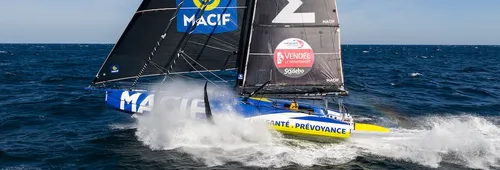
- Sam Goodchild (FRA / GBR) – MACIF SANTÉ PRÉVOYANCE
- Corentin Horeau (FRA) – MACSF
3 WOMEN ON THE START LINE
With Élodie Bonafous, Francesca Clapcich and Violette Dorange among the competitors, women represent one-third of the fleet.
Three different profiles, three remarkable journeys, but one shared objective: cross the Arctic Circle and gain as much solo racing experience as possible.
This growing diversity reflects the evolution of offshore racing, where women and men compete on equal terms, under the same conditions and with the same demands.
4 NATIONALITIES REPRESENTED
The Vendée Arctique also highlights the increasing internationalisation of the IMOCA class. Four nationalities will be represented in this edition: France, Italy, Great Britain and the United States.
Italian skipper Ambrogio Beccaria, Italian-American sailor Francesca Clapcich and Franco-British skipper Sam Goodchild embody this new generation of international sailors.
7 ROOKIES IN THE VENDÉE ARCTIQUE
Among the nine skippers entered, seven will be competing in the Vendée Arctique for the first time.
This statistic underlines the significant renewal of the fleet since the last Vendée Globe.
For many, this race represents a first encounter with the high latitudes, a first experience of the Far North, and a key milestone in building their Vendée Globe 2028 campaign.
66°34’ NORTH: THE SYMBOLIC MARK OF THIS EDITION
This is the figure that perfectly encapsulates the uniqueness of the 2026 edition.
66°34’ North: the exact latitude of the Arctic Circle.
For the first time in offshore racing history, skippers will have to cross this symbolic line solo.
More importantly, they will enjoy complete strategic freedom: each sailor will be free to choose the longitude at which they cross.
No prescribed route. No mandatory waypoint.
Each skipper will have to build their own course according to weather systems, sea ice, exclusion zones, sea state and their ability to manage their boat in the high latitudes.
This total freedom is expected to generate widely differing strategies and increase the sporting uncertainty even further.
In these northern waters, the usual reference points disappear.
Darkness barely falls. Temperatures drop. Low-pressure systems follow one another across a cold and unstable ocean.
3,500 NAUTICAL MILES OF RACING
The theoretical course distance is estimated at around 3,500 nautical miles.
In reality, however, the final mileage could be very different.
With a completely open course, routes may vary considerably depending on the options selected by the skippers. Some may favour a more direct and committed route, while others may choose greater safety or more favourable weather conditions.
As a result, the 2026 Vendée Arctique could become one of the most strategic races of the current IMOCA cycle.
8 TO 10 DAYS AT SEA
The race is expected to last between eight and ten days.
A short but exceptionally intense challenge.
In the North Atlantic, weather systems evolve rapidly. Sailors will need to perform constant manoeuvres while managing fatigue, cold temperatures and often confused sea conditions.
There will be little time to recover.
In the Far North, manoeuvres come thick and fast, often in cold temperatures and rough seas.
Time gaps could open up — or close down — extremely quickly depending on the strategic choices made and the rapidly changing weather systems of the North Atlantic.
24 HOURS OF DAYLIGHT AT THE ARCTIC CIRCLE
At the heart of the Far North, the skippers will sail in permanent daylight.
Sleepless nights, an endless horizon bathed in light, and an almost unreal atmosphere in the middle of the North Atlantic.
A fascinating environment, but one that can also disrupt sailors’ physiological rhythms and sleep patterns.
In June 2026, the Vendée Arctique will not simply take skippers north.
It will take them into a part of offshore racing that remains largely unexplored.