


When Time Starts to Slow Down
There is a paradox in offshore racing that every sailor knows well. When the finish is still far away, the days pass naturally at the rhythm of life at sea. When it draws near, the perception of time somehow changes. The hours become longer, impatience creeps in and the body starts thinking about land before the boat has actually reached it. “They often say that the final miles are the longest. I think that will definitely be true at the end of this Vendée Arctique,” admits Manu Cousin. “I’m really in the arrival funnel now. I’ve reached the tip of Brittany and, until yesterday, a Saturday evening finish was still possible. Unfortunately, the wind is fading and I now expect to arrive on Sunday morning instead. That’s what creates the feeling that everything is stretching out: this very light wind that could stay with me all the way to the finish.” For several days, the weather has been testing the patience of the Coup de Pouce skipper. After the fronts, the gusts, the long upwind stretches and the numerous light-air zones that have punctuated his race, another pocket of weak winds now threatens to delay his return even further. It is a frustrating situation. But also a familiar one for sailors. The final miles have a peculiar talent for feeling longer than the thousands already sailed.
The Body Starts Presenting the Bill
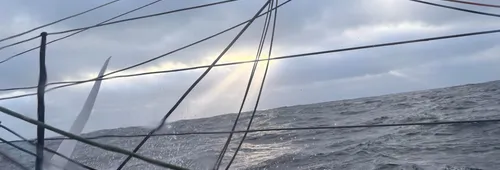
Thirteen days after leaving Les Sables d’Olonne, fatigue has settled everywhere. In the movements. In the reactions. Even in the eyes. At this stage of the race, the battle is no longer fought solely on the water. It is also fought within the body itself. “Right now, I’m mainly focused on what still needs to be done. I can’t afford to make a mistake. The fatigue is definitely there, I’m starting to feel really exhausted and I need to stay concentrated to bring the boat back to Les Sables d’Olonne in perfect condition.” For several days, the sailor has been living in a grey, damp atmosphere that seems unwilling to lift. “At the moment I’m still in the fog and I can’t see very much outside. So I keep monitoring the boat settings, the AIS and the radar. I’m hoping to see a bit of sunshine again because I’m starting to miss it quite seriously.” On board, however, the rhythm has not changed. Since the start, sleep has come in fragments. A few minutes stolen here. Half an hour grabbed there. A fragile balance that has gradually become routine, but whose effects are now beginning to weigh more heavily. The level of vigilance, however, must remain absolute. Because the final miles are often the most deceptive. Not because they are the hardest to sail. But because they arrive precisely when fatigue reaches its peak.