

All news

When the Race Becomes an Inner Journey

Last night, Nico d’Estais (Café Joyeux) crossed the finish line of the Vendée Arctique – Les Sables d’Olonne. A few hours later, in the middle of the night, Arnaud Boissières (APRIL Marine) followed suit. Now, only one IMOCA remains at sea between the High North and Vendée: Manu Cousin’s (Coup de Pouce). It is a particular situation that gradually changes the very nature of the race. When the others are already back ashore, when the pontoons are filled with reunions and the rankings appear settled, different motivations are needed to keep moving forward. More personal motivations. Deeper ones, too.

Manu Cousin (Coup de Pouce)

Alone with the Race

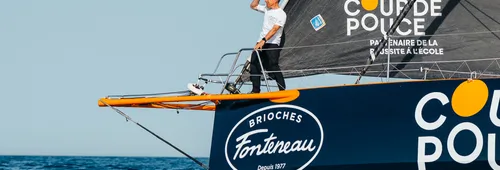
There comes a moment in offshore racing when competition is no longer measured solely against others. For Manu Cousin, that moment arrived several days ago. The series of technical issues encountered since the start—largely the consequence of a late relaunch and work carried out on the boat over the winter, some aspects of which had never previously been tested in such demanding conditions—gradually distanced the sailor from Les Sables d’Olonne from the leading group. Since then, the gaps have become established and the challenge has shifted. “I’ve accepted it. The race, as far as the rankings are concerned, is behind me now. My objective is simple: bring the boat home as quickly as possible and in the best possible condition. It’s still a race, but now it’s a race against the clock and against myself.” The situation demands genuine mental resilience. Continuing to battle offshore while the leaders have already returned to land is no small thing. “Of course, seeing the others finish always creates a little pang of emotion. It’s a bit like the Vendée Globe: when your friends cross the line and you’re still a long way behind, it inevitably reminds you of how much the gap has grown.” Yet the Coup de Pouce skipper refuses to dwell on frustration. As the miles pass beneath the keel, he prefers to focus on everything this Vendée Arctique has taught him.

I’d rather focus on everything I’ve learned from this race. Even in this ‘defeat’, if you want to call it that, there are a huge number of lessons for the future of the project.


Upwind, Then More Upwind

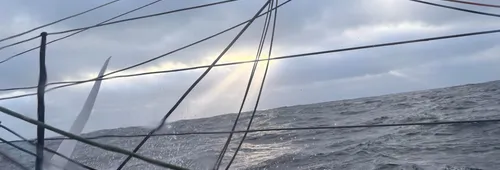
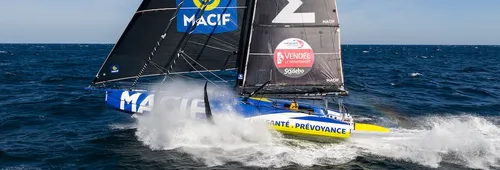
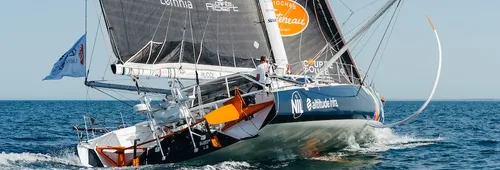
As if that were not enough, the weather continues to offer no respite. For more than forty-eight hours, Manu Cousin has been stringing together upwind legs in a North Atlantic that continues to impose its own rules. While the leaders blasted along the Irish coast at high speed on a reach, regularly exceeding 30 knots, the sailor from Les Sables d’Olonne is living a very different story. Strong winds. Light airs. More strong winds. Then almost no wind again. A constant alternation that demands endless maneuvers and makes it impossible to establish any real rhythm. “I basically have two modes: either 25 to 30 knots of wind or almost nothing. There isn’t much in between. It generates a huge number of maneuvers. I put reefs in, shake them out, hoist more sail again... At least I’m not getting bored!” His IMOCA is currently passing west of Green Island, making slow progress on a point of sail that is particularly demanding for both sailor and machine. Another front is expected to sweep across him on Thursday before conditions become more manageable once again. The iconic Fastnet lighthouse should be rounded during the afternoon. Only then will come the Celtic Sea and the English Channel, with arrival now expected sometime on Sunday, either during the day or in the evening.

Manu Cousin (Coup de Pouce)

Turning Setbacks into Experience

In these circumstances, it would be easy to focus only on what has gone wrong. Manu Cousin chooses a different perspective. Since the start, this Vendée Arctique has acted as a giant test bench for his project. “This race has also been a fantastic source of information. We came here to test the boat in real racing conditions and, from that point of view, we’ve certainly been served. We identified a lot of things. Some are part of the normal life of a project. Others, however, will need to be resolved and must not happen again.” Because despite the technical issues, the problems encountered with certain onboard systems and the hours spent repairing things when he would rather have been racing, the overall conclusion remains positive.The weaknesses have been identified. So have the areas for improvement. “The advantage is that in a race you push the boat much harder than in any other situation. Everything we’ve discovered here is going to help us improve. For the next races, I’d like to spend less time repairing things and more time sailing, racing and battling with the group where I believe I belong.” Until then, several hundred miles still remain. And until the finish line is crossed, a race is never truly over. Manu Cousin knows that better than anyone. So he keeps pushing. Tack after tack. Mile after mile. With the same determination that has driven him since the start.


Share this article

Latest news