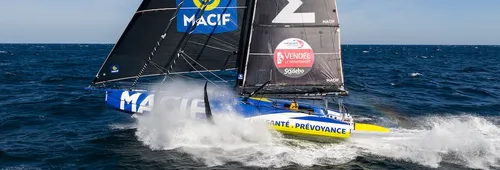




By crossing the Arctic Circle, competitors will sail through a region where climate change is unfolding with unmatched speed and intensity. Temperatures there are rising up to four times faster than across the rest of the planet. This phenomenon is disrupting ocean balances, ecosystems and the living conditions of nearly four million inhabitants.
By choosing the Arctic as its playing field, the race embraces a responsibility: to shine a spotlight on a region undergoing rapid transformation while raising public awareness of issues that concern us all.
Why is the Arctic warming faster than the rest of the world?
This phenomenon, known as Arctic amplification, is monitored and documented by scientists at 'IFREMER. Camille Lique, researcher at IFREMER and coordinator of the CLIMArcTIC project CLIMArcTIC, summarises it this way: sea ice is becoming younger, thinner, more mobile and more fragile. At the same time, the surface layer of the ocean is becoming fresher and more acidic, profoundly altering primary production, marine ecosystems and the food chain.
Scientists sometimes compare Arctic transformations to the « canary in the coal mine »: an early warning signal of the environmental upheavals the rest of the planet could experience in the coming decades. A signal that Vendée Arctique skippers will witness with their own eyes.
What are the consequences of Arctic warming?
The impacts of climate change in the Arctic are multiple and interconnected:
- Sea ice: rapid decline of sea ice, which is becoming younger, thinner and more fragile
- The ocean: freshening and acidification of the surface layer
- Ecosystems: disruption of primary production, marine wildlife and the food chain
- Local populations: nearly four million inhabitants facing profound transformations in their environment and resources
- Regional economy: the emergence of new activities (resource extraction, tourism and shipping) reshaping socio-economic balances
- Global climate: the risk of disruptions to global oceanic and atmospheric circulation, with consequences far beyond the region itself
The Arctic: a vast and heterogeneous region
The Arctic is not a uniform entity. It is a vast region made up of highly diverse environments, ecosystems and cultures. The impacts of climate change will not be identical in Baffin Bay (west of Greenland) and in the Chukchi Sea (north of the Bering Strait). While all climate models project an intensification of change, they diverge regarding the pace and scale of transformations depending on the region. The scientific community is therefore working to produce more precise and operational regional forecasts.
The CLIMArcTIC project: scientific partner of the Vendée Arctique
To support the race in its awareness-raising mission, the CLIMArcTIC project ill be present in the Vendée Arctique race village. The exhibition « The Arctic: an ocean in transition » invites the public to explore the latest scientific knowledge on climate transformations, the richness of Arctic ecosystems and the challenges faced by local populations.
CLIMArcTIC is a research programme led by IFREMER, bringing together 12 partner institutes and around fifty researchers and engineers from a wide range of disciplines: physical oceanography, glaciology, climate dynamics, artificial intelligence, biology and anthropology. The programme was selected as part of the Priority Research Programme dedicated to Oceans and Climate.
FAQ: the Arctic and climate change
Why does the Vendée Arctique pass through the Arctic Circle?
The Arctic Circle lies at the heart of the Vendée Arctique route, making this race far more than a sporting challenge. It places skippers and the public face to face with one of the regions most transformed by climate change, while helping raise awareness of global environmental issues.
Why is the Arctic warming four times faster than the rest of the planet?
This phenomenon is known as Arctic amplification. It is mainly linked to the melting of sea ice: white ice reflects solar heat, but as it disappears, it gives way to darker ocean waters that absorb more heat. This vicious circle accelerates local warming far beyond the global average.
What is sea ice and why is it under threat?
Sea ice is a layer of frozen seawater that forms on the surface of the Arctic Ocean.
As a result of climate change, it is becoming younger, thinner, more mobile and more fragile.
Its decline is one of the fastest and most visible manifestations of climate change on a global scale.
What are the risks of Arctic warming for the rest of the world?
Arctic warming could trigger changes in global oceanic and atmospheric circulation, with consequences for climates around the world. This is why scientists consider the Arctic an advanced indicator of the environmental upheavals to come.
What is the CLIMArcTIC project?
CLIMArcTIC is a French scientific research programme led by IFREMER, bringing together 12 partner institutes and around fifty specialists. As a partner of the Vendée Arctique, it will be present in the race village with an exhibition dedicated to climate transformations in the Arctic region.