

All news

The importance of staying one step ahead

Whilst the frontrunners are set to reach the Arctic Circle tonight, everyone is already fine-tuning their strategy for what comes next. After all, it’s not just a matter of reaching it, but of plotting the route to ensure the fastest descent to Les Sables-d’Olonne. It’s a strategy that’s anything but straightforward, especially for the frontrunners.

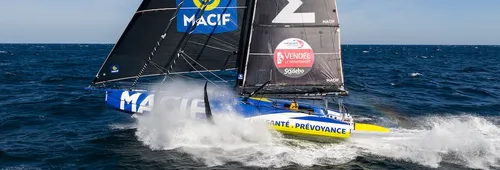
Macif Santé Prévoyance, actuellement en tête de la course.
© DR

A new race calls for a new approach. This third edition of the Vendée Arctique presents the skippers with a unique challenge: to reach the Arctic Circle at a point they must define themselves before heading back down to Les Sables-d’Olonne. “What you need to understand is that the best point of arrival isn’t necessarily the best point to start the descent,” explains Christian Dumard, the race’s meteorologist. “The choice made will depend mainly on the strategy for the second half of the race. In terms of planning, it’s quite complex.”

“It’s important to think about what you do next”

In addition to manoeuvres, sail trimming and constant monitoring on board, they therefore have to rack their brains. A process the sailors have been engaged in for several days. “It’s important to think about what you do after you’ve turned around,” explained Arnaud Boissières (April Marine – research co-partner) yesterday. “What we’re trying to avoid is heading back down with a headwind; it’s less pleasant and, above all, slower. But it can be advantageous by causing slowdowns at the front of the fleet.” 

Currently leading the fleet, Sam Goodchild (Macif Santé Prévoyance) and Élodie Bonafous (Association Petits Princes – Quéguiner) are expected to cross the Arctic Circle during the night between Wednesday and Thursday. But where exactly will they cross it? “They’ll adjust their course during the day,” says Christian. “The decision will probably be made at the last minute depending on how conditions develop,” explains Sam Goodchild (MACIF Santé Prévoyance). “I’m trying to keep as many options open as possible.”

This morning, Élodie echoed this sentiment: “I don’t yet know exactly where I’ll be passing through. Western Iceland is no longer an option given where we’ve headed. I’ve decided to leave a restricted zone (the North Atlantic Biodiversity Protection Area) to port, and now I’ll adapt according to the small weather systems and low-pressure systems moving through. I’m giving myself plenty of room for manoeuvre because I still have time.” 


To fly west of Iceland, very specific conditions would have been required, in particular a low-pressure system at a lower altitude that was sufficiently stable

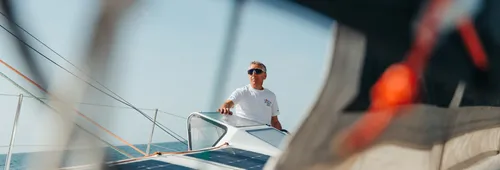
Nico D'Estais
Café Joyeux

What lies ahead: a balance of daring and caution

The stakes are high because, after crossing the Arctic Circle, the shortest route takes them through a significant area of calm (a windless zone). “Either you head west to find wind and get past this area, or you head east, but that means sailing close-hauled,” explains Christian Dumard.

This choice will also set the tone for the next decision: heading south via the east of England, between Ireland and England, or to the west. The eastern route looks particularly daring, especially as conditions in the English Channel are not expected to be straightforward and one must watch out for oil rigs and traffic. “It’s not an option I’m keen on; it’s a very dangerous route, as we saw in the Course des Caps,” recalls Élodie.

Ambrogio Beccaria (Allagrande Mapei) also admitted that he “doesn’t plan to take a route east of Great Britain”. “It would be a huge source of complications, a risky option, and I’d much rather have two more days of close-hauled sailing in strong conditions,” explains the Italian. However, most of the routings take the boats between Ireland and Great Britain, with another further east.

Things are getting tense at the back too

What about the skippers trailing the leading duo? “I’m going to keep heading north and north-east, just like the lads up front,” explains Arnaud Boissières (April Marine – research co-partner). “I have several potential crossing points in mind for the Arctic Circle.” Nico d’Estais (Café Joyeux) also mentions “something classic”, “envisaging a passage north of the Faroe Islands, even if there are still some uncertainties”. However, like the leading skippers, they have all ruled out the possibility of skirting Iceland to the west.

“It never really convinced me because it involved a significant detour,” explains Arnaud. “It would have required very specific conditions, notably a low-altitude depression that was sufficiently stable,” agrees Nico d’Estais. Even if they do not pass to the west of Iceland, there is still plenty of “play” left. In short, everything remains to be decided at every level to determine the winner, the podium and the places of honour in this Vendée Arctique, a race brimming with freshness and suspense!

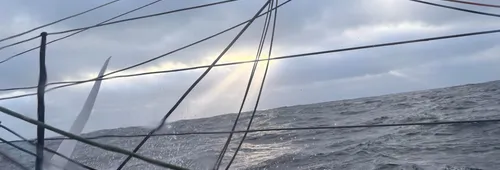
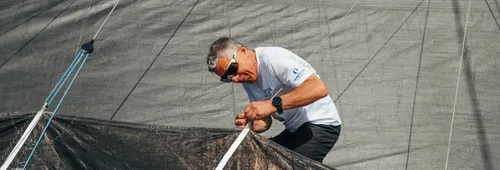
À bord d'April Marine - recherche co-sponsor.
© DR

Share this article

Latest news