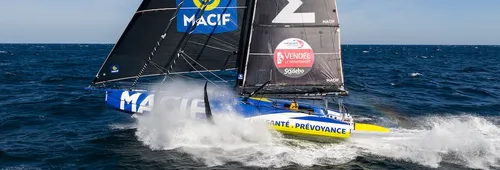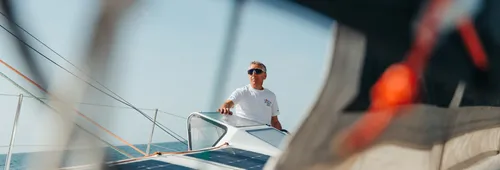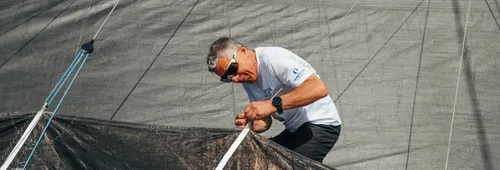


Sam Goodchild (MACIF Santé Prévoyance) : “I’m in the North Channel now. It’s actually quite enjoyable because I’ve been sailing along the coast for several hours. At times, I’m only three miles offshore and I’ve just passed Belfast. It almost feels like a sightseeing cruise in the middle of a race! It’s an area I know fairly well. I’ve sailed here several times in the Figaro Beneteau, on a MOD70 and, I think, even in an IMOCA. Honestly, that experience helped influence my decision. When you’re alone on board and have to negotiate such a particular passage, it’s reassuring to know the playground already. That’s one of the reasons I chose this option. I even had a visit from a group of dolphins at the entrance to the channel. They arrived just as the sea started to flatten out. I tried to film them, but they disappeared almost immediately. It was a lovely moment. What really feels good, though, is having a much flatter sea again. After several days in rough conditions, finally seeing the water calm down is a huge relief. The wind remains very unstable because of the surrounding terrain, so you still need to stay attentive to the sail trim, but with less sea state, everything becomes easier to manage. That’s really the challenge of this passage. The channel is narrow, the wind funnels down from the Irish hills in a very irregular way, and there’s very little room for error. When sailing solo on an IMOCA, you have to accept compromises. I came this way because it was strategically the best option, but in return I’m deliberately sacrificing some performance in exchange for safety. All my manoeuvres and sail changes are carried out in areas where I have room to operate and where I can maintain a safety margin. For a large part of this transit, I’ll probably be sailing at only 60% of the boat’s potential. But that’s entirely intentional. I want to remain in control if the wind builds more quickly than expected or if the traffic becomes denser. The next step is to continue sailing close to the coast to maximise the shortcut offered by the channel. I should exit St George’s Channel early tomorrow morning. There will be a transition zone to negotiate, but every competitor will have to deal with it, whether they passed inside or outside Ireland. The real difference will probably come afterwards. What’s reassuring for those of us taking this route is that once through the transition, the wind should gradually return. Even if we slow down for a while, we know the weather systems will eventually catch up with us. After that, we should enjoy a more favourable angle towards France than the boats that went west of Ireland.”
“You Have to Fully Commit to the Opportunities That Present Themselves”
SAILORS’ VOICES The landscapes of the High North are gradually disappearing in the wake of the IMOCA fleet. After brushing the Arctic Circle and the high latitudes, the competitors are slowly returning to more familiar waters, though the pressure remains as intense as ever. Between the impressive reaching speeds, the strategic choices around Ireland and the management of fatigue accumulated since the start, each skipper continues to fight their own battle. During today’s media call, Sam Goodchild (MACIF Santé Prévoyance), Elodie Bonafous (Association Petits Princes – Quéguiner) and Arnaud Boissières (APRIL Marine) described a return leg already proving highly demanding, with plenty more challenges still lying between them and Les Sables d’Olonne.


Elodie Bonafous (Association Petits Princes – Quéguiner) : “At the moment, I’m calling it the 1,400-rpm spin cycle program! It’s not necessarily very pleasant, but it’s incredibly effective! The bursts above 32 knots keep coming and the boat certainly isn’t being gentle with its skipper.The beginning of the night was a little complicated because I really wanted to get below the traffic separation schemes before changing configuration. So I kept a reaching sail up longer than I should have, which initially cost me some speed. But the main objective was to arrive with the right angle for my strategic option. Now I’m trying to claw back the few miles Ambrogio has taken from me over the past several hours. I can confirm that I’m going through the North Channel. That doesn’t particularly worry me because I’ve already sailed there in a Figaro Beneteau. In fact, that experience was one of the factors that tipped the balance. And on paper, it’s a very attractive option. It’s shorter and also helps avoid a ridge of high pressure that could penalise those rounding Ireland to the west. What reassures me as well is that I’ll reach the most demanding sectors during daylight, particularly the entrance and the traffic separation scheme. After that, the wind is expected to ease gradually. That’s another argument that reinforced my decision. Of course, there are more risks involved with this option. You’re sailing closer to the coast in a more confined area. But there are advantages too. The sea becomes much flatter and, in reality, there isn’t that much traffic outside the main shipping routes. It’s definitely an area where vigilance is required, but I’m fairly relaxed about it. Another advantage is that the shorter route gives you greater freedom to slow the boat down if necessary. I’m currently identifying all the areas that require particular attention and thinking carefully about how to manage my fatigue. After several days under almost continuous daylight, we’re going to experience genuinely dark nights again and I think that will be important. We’ll need to avoid falling asleep in the wrong place. Honestly, I didn’t hesitate very long before choosing this route. Firstly because I already know the area. And secondly because I’m a little frustrated to have seen Ambrogio and Violette come back at me. My objective remains to defend second place, so you have to fully commit to the opportunities that present themselves. Since the start, this race has been extremely intense. There have been countless manoeuvres, numerous transitions and very few opportunities to recover. But I didn’t come here to rest. I’ll sleep when I get back ashore! In the meantime, I’m still trying to lie down whenever possible, even if I don’t actually sleep. Standing up, constantly braced against the movement of the boat, consumes a huge amount of energy. I’m also forcing myself to eat and drink regularly to keep my energy levels up. My goal is to get a proper period of rest before entering the North Channel, which I should reach during the middle of the afternoon.”
Arnaud Boissières (APRIL Marine) : “It’s quite funny because I’m almost exactly where I was thirty-six hours ago, except this time I’m on a downwind course. The scenery hasn’t changed, but the conditions are completely different. The wind is irregular and occasionally a little light, but overall it’s actually quite pleasant. My Arctic Circle crossing happened in rather unexpected circumstances. I was preparing for a major manoeuvre when suddenly the wind disappeared. For an hour and a half there was almost no breeze at all. It allowed me to hoist my sail cleanly without too much trouble. And at exactly the same time, the sky cleared. The light became magnificent. Honestly, it was a wonderful moment. It really made me smile. You definitely find atmospheres up here that are reminiscent of the Southern Ocean. These very particular light conditions, the constantly changing weather and the omnipresent humidity... It’s cool without being freezing, but you’re outside all the time and eventually you feel it. I brought a few mountain hand warmers with me and I certainly don’t regret it! They’ve been very useful. It’s another box ticked in a sailor’s career. These are regions that very few sailors have had the chance to visit. I even crossed paths with a cargo ship far to the north and it struck me that these waters are still travelled by very experienced mariners. It definitely makes me want to come back one day—though as a cruiser rather than during a race! Now it’s time to focus on the return leg. For once, the weather models seem to agree reasonably well.The wind we’re currently experiencing should be the strongest of the descent. After that, it looks quite varied: downwind sailing, reaching and even a little upwind work at times. But overall, conditions should remain favourable for making quick progress towards home. What’s also encouraging is that I’m gradually closing the gap on Nico d’Estais. I’m fortunate enough to sail a fairly direct route while he has to manoeuvre more frequently. I lost ground a few days ago, so it’s nice to gain some back. The outlook remains promising, even if it appears likely to be very grey and probably quite rainy. But when you choose to sail this far north, you know what to expect! And if you don’t like water, you probably shouldn’t go sailing... I’m also keeping an eye on what’s happening further ahead. Watching Sam in the North Channel is impressive. It must be both magnificent and fairly stressful.I also find Ambrogio’s option very interesting. What really stands out are their speeds. They’re sailing at more than 25 knots almost constantly. It’s quite incredible to watch. As for us, there’s still a long way to go. There are more than a thousand miles left. We’re still right in the middle of the story. So I’m staying focused, clear-headed and highly motivated for what comes next.”