

All news

The final stretch in five questions

A leader who could falter, a mass finish, arrival times that keep getting pushed back… This final stretch promises to be nail-biting right to the very end. We sit down with Christian Dumard, the race’s meteorologist, and the race organisers to analyse what lies ahead for the skippers as they head for the finish line.

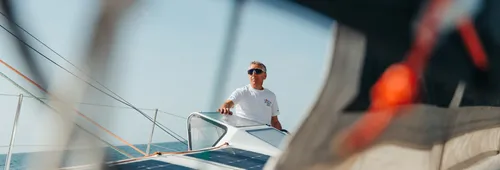
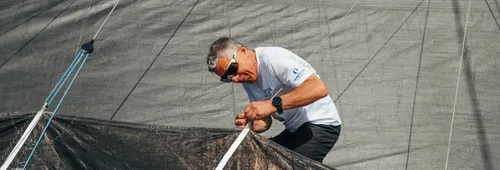
À bord de MACIF Santé Prévoyance.
© DR

Why does the final stretch look so uncertain?

It has become one of the main concerns for the skippers at the front of the fleet: this large area of calm winds that is gradually forming in the Bay of Biscay. By Sunday evening, it will already form a giant barrier stretching from northern Finistère to the latitude of Bordeaux. As the hours pass, the area will move eastwards, drawing closer to Les Sables-d’Olonne until Tuesday morning. “This type of area is quite typical during the summer,” explains Christian Dumard. The top five will therefore have to adapt, trying to make the most of the slightest shift in the wind to gain the upper hand over their rivals.

Why is Sam Goodchild’s lead under threat?

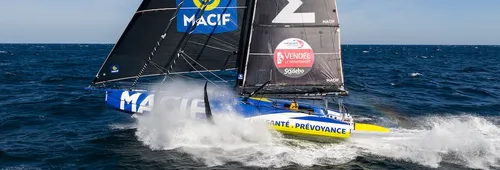
Having led the race since the day after the start, the Macif Santé Prévoyance skipper heads into the final stretch as the leader. He will therefore be the first to face this windless zone and consequently have to adapt to it. It could be a tough situation if he gets stuck in the calm and sees the others closing in on him. Sam would therefore be forced to take the lead, and the others will see whether his route works or not. The race will therefore be more open than for his pursuers.

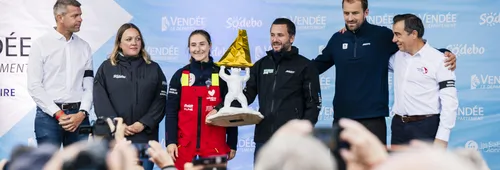
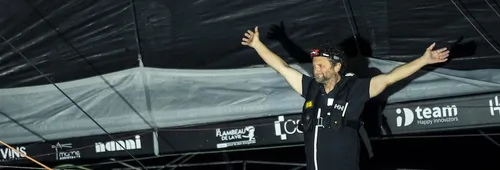
À bord d'Allagrande Mapei.
© DR

What are the possible strategies? 

Two options appear to be emerging to avoid this windless zone. The first, supported by the routings, involves heading south into the heart of the Bay of Biscay before turning east and setting course for Les Sables d’Olonne. Another option is to sail along the coast of Brittany as far as the Vendée. “The problem is that on arrival, the angle isn’t as good,” explains Christian. “The skippers would find themselves sailing downwind just as the wind picks up, which would force them to tack.” On the other hand, the southern option allows them to “arrive on a tack”. Added to all this is the effect of fatigue accumulated since the start of the race. “We’ve already noticed that the boats are slower during transitions precisely because of fatigue,” agrees the meteorologist.

When will the first competitors cross the finish line? 

This period of calm winds makes it difficult to formulate strategies or to get a clear idea of the estimated times of arrival (ETAs). “At this stage, an arrival on Monday evening is unlikely,” says Christian Dumard. “It is more likely that they will arrive late at night, between Monday and Tuesday.” Sam Goodchild is expected between 10 pm (Monday) and 6 am (Tuesday). His pursuers could cross the line between 6 am and 10 am the following morning. Furthermore, the skippers will need to keep an eye on the tide, which determines when the channel opens. It will be open between 3 am and 8.30 am, i.e. in the second half of the night. Will this provide a spectacular early morning finish to catch the first light of day? Watch this space. 

What about the rear of the fleet? 

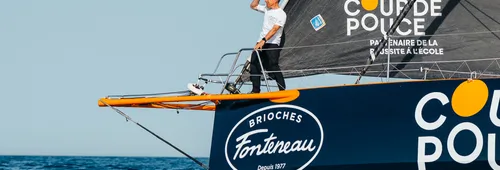
Nico d’Estais (Café Joyeux, 6th) and Arnaud Boissières (April Marine – recherche co-partenaire, 7th) have passed Scotland and are heading towards the north of Ireland. “The pair are making good progress downwind,” says Christian Dumard. “They’re looking for a wind shift ahead of a low-pressure system to keep moving forward.” The two sailors, currently separated by around a hundred miles, are expected to cross the finish line during the night of Wednesday to Thursday or at some point on Thursday. Meanwhile, Manu Cousin (Coup de Pouce, 8th) crossed the Arctic Circle yesterday. He too will be affected by the low-pressure system from Tuesday onwards. While it is still difficult to give a precise ETA, he could cross the line next Sunday. 


Share this article

Latest news