

All news

The Route to the Arctic Circle Is Open

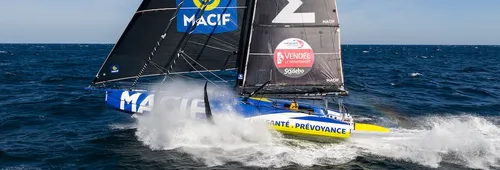
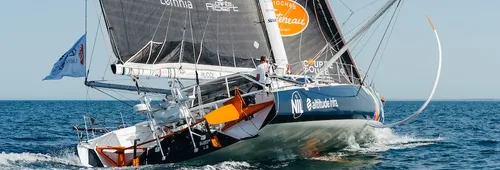
The nine IMOCA skippers competing in the Vendée Arctique – Les Sables d’Olonne set off this Sunday at 13:02 local time. In a hesitant southerly breeze fluctuating between 4 and 7 knots, the tightly packed fleet left Les Sables d’Olonne without drama. A seemingly gentle start. Yet behind this smooth departure already lies the outline of a demanding and complex race. The first tactical choices emerged as soon as the fleet cleared the bay, transition zones await as early as tonight, a frontal system is expected on Monday morning, and a lively climb towards Irish waters will follow. The sailors will have little opportunity to settle into any sort of routine. As for what comes next, the picture remains largely open. While the forecasts still broadly agree through the middle of the week, they diverge significantly thereafter. An uncertainty that mirrors the nature of this extraordinary race, which will take the fleet all the way to the latitude of the Arctic Circle.

Départ

A Deceptive Calm

The sails took time to fill and the boats took time to find their rhythm. Yet nobody expects a relaxed opening phase. In such light airs, gains are rarely made through a brilliant strategic masterstroke. More often, they come from making the most of a favourable puff, positioning the boat slightly better or executing a manoeuvre at precisely the right moment.

“There are already two routes beginning to emerge,” explained Corentin Horeau before the start. “One offshore and another closer to the coast. It’s a bit of a knitting exercise to begin with.” Beneath its calm appearance, this opening day already demands complete concentration. The sailors are navigating within an unstable airflow while the sea state gradually begins to build.

In these conditions, the fleet sometimes resembles a group of hikers standing at a poorly marked crossroads: everyone is looking at the same signpost, but nobody is interpreting it in quite the same way. For her part, Elodie Bonafous prefers to remain pragmatic. “Yesterday there were still a few very specific opportunities to exploit. That’s less true today. Out on the water, the key will simply be to work with what’s there. Keep the boat moving and chase the wind whenever it shifts.”

A philosophy that may well define the opening stages of the race: adapting to what the weather offers rather than trying to impose a preconceived scenario upon it.

A Race That Quickly Raises the Stakes

The calm observed at the start is unlikely to last.

As early as tomorrow morning, a first frontal system will reshuffle the deck before conditions gradually build on the route towards the Celtic Sea.

We’re going to get into the thick of it fairly quickly

Corentin Horeau
MACSF

“The breeze will start filling in overnight. After that, the forecasts show the strongest conditions between the English Channel and Ireland.” The sequence promises to be demanding. Changes in pace are expected to come thick and fast, accompanied by a constant succession of manoeuvres and sail changes. “There’s going to be plenty to do,” summed up Nicolas d'Estais. “Up to Ireland, we definitely won’t be bored.”

Ambrogio Beccaria shares that view. The lack of pressure at the start does not mean the sailors will have time to relax. “Between the wind shifts and the swell that will gradually build, finding the right boat speed won’t necessarily be straightforward.” The challenge will not come solely from the weather. Throughout this first section of the course, opportunities to switch off will be rare. “We’re crossing areas with a huge amount of traffic,” reminded Manu Cousin. “Cargo ships, fishing vessels and the other IMOCA boats. Sleep periods will inevitably be very short.”

Already, attention is turning towards the west coast of Ireland, the first real benchmark of the 2026 edition. “That’s probably where things will start becoming more serious,” anticipated Sam Goodchild, recent winner of the 1000 Race. “We could see between 25 and 30 knots of wind and a well-developed sea state. Those aren’t exceptional conditions for our boats, but they still demand a great deal of attention.”

Where the Charts Become Less Clear

Up to the climb towards Ireland, the broad picture remains relatively easy to read. The main weather models are still telling a fairly similar story. Beyond that point, certainty begins to fade. “The models are very different,” observed the British navigator. “They’ve changed every day for the past week.”

A situation that is almost inevitable at these latitudes, where low-pressure systems follow one another in quick succession. For now, the skippers prefer to focus on the immediate horizon. “I think we’re all mainly concentrating on what happens up to Ireland,” explained Corentin Horeau. “The forecasts are fairly consistent until then. After that, we’ll have to rebuild the analysis as we go because up there the scenarios evolve quickly.”

The same conclusion is shared by Nicolas d’Estais. “From Wednesday onwards, the weather is far from settled. A lot can still change.” That is perhaps one of the defining characteristics of this Vendée Arctique. The nine solo skippers know their destination: the Arctic Circle at 66 degrees north. What none of them yet knows is what form the route will take to get there. The start unfolded in gentle conditions. The High North, however, has yet to reveal its hand.

Départ
Un sport où la mixité est possible | Vendée Globe 2026

Share this article

Latest news