

All news

When the Fastest Route Isn’t Always the One You Choose

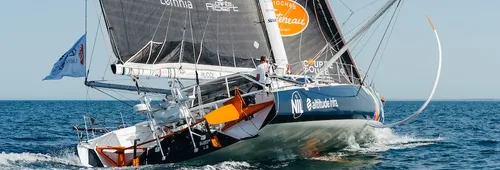
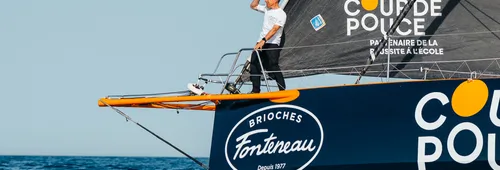
The High North is gradually fading into the fleet’s wake. Following Nicolas d'Estais (Café Joyeux) yesterday in the early afternoon and Arnaud Boissières (APRIL Marine) shortly before 20:00, seven of the eight competitors still racing have now crossed the Arctic Circle. Only Manu Cousin (Coup de Pouce) continues his climb towards higher latitudes. For everyone else, the bow is now pointed towards Les Sables d’Olonne. Aboard the IMOCA fleet, speeds are soaring. Driven by 25 knots of wind, with gusts reaching 30 knots, and seas building to four metres, the sailors are once again averaging more than 20 knots. The foils are singing. The bows are flying. And the miles are disappearing fast. Yet behind these impressive speeds lies another challenge: choosing the return route. Between Ireland and Great Britain, a narrow passage is attracting the routing models, dividing the fleet and forcing each skipper to balance performance against risk.

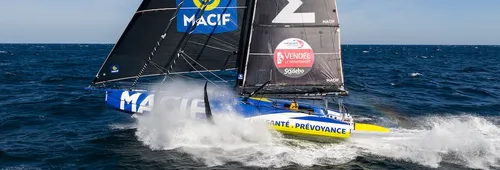
MACIF Santé Prévoyance
© Sam Goodchild

Between Cliffs, Currents and Legends

The Vendée Arctique – Les Sables d’Olonne had already captured the imagination on the outbound leg. The Hebrides. The Faroe Islands. The Arctic Circle. And glimpses of Iceland through gaps in the fog. Names that resonate far beyond the charts themselves. The return leg is proving no less remarkable. To regain the Atlantic, several competitors are preparing to thread their way between Ireland and Great Britain via the North Channel. At its narrowest point, in the Strait of Moyle, the two coastlines are separated by barely twenty kilometers. A confined stretch of water is complicated further by tidal currents, shipping traffic and traffic separation schemes. It is also a place steeped in history and mythology. According to a famous Irish legend, it was here that the giant Fionn Mac Cumhaill built the Giant’s Causeway to reach Scotland. Today, it is a fleet of high-speed IMOCA yachts heading through these waters. Their concerns, however, are rather different from those of Celtic heroes. Because for the sailors, this maritime corridor is not merely a geographical curiosity. It is one of the defining strategic decisions of the closing stages of the race.

The Fastest Route Isn’t Always the One You Choose

For Sam Goodchild, there is no hesitation. The race leader is currently committing his IMOCA to the North Channel. Elodie Bonafous follows the same logic. On paper, the option is attractive. Shorter. More direct. And, according to the current routing models, it is significantly faster. But not everyone is convinced. Having moved back into third place yesterday after overtaking Violette Dorange and putting pressure on Elodie Bonafous, Ambrogio Beccaria has chosen a different path. The Italian has decided to leave Ireland to port and round it via the west. “When I look at what’s on the menu—strong winds, rough seas, adverse current, a traffic separation scheme to negotiate in a narrow passage—honestly, it makes my stomach turn. I’m not feeling it.” The Italian skipper is fully aware of what he may be sacrificing. “The worst part is that I know it’s probably the winning route. My routings sometimes give it an advantage of 50 to 60 miles.” But for a sailor competing in his first solo IMOCA race, the calculation goes far beyond pure performance. A recent scare involving his autopilot only reinforced his thinking. “If the same thing happens in the wrong place, it could quickly become a real drama.” The decision is therefore entirely deliberate, even if it may cost him several positions. “I feel a little bit like I’m the only one going against the tide on this one!”

APRIL Marine - recherche co-partenaires
© Arnaud Boissières (APRIL Marine - recherche co-partenaires)

To Each Their Own Route, To Each Their Own Gamble

Behind this divide between the inside route and the outside route, nothing is entirely settled yet. Violette Dorange is still weighing up the pros and cons.


I’ve been turning the problem over in my head for several hours. At the moment, I’m leaning more towards rounding Ireland to the west. The inside option remains attractive on paper, but it also seems significantly riskier.

Violette Dorange
Initiatives-Cœur

The skipper of Initiatives Cœur, already penalised by the loss of her MH0 (Masthead Zero), a particularly valuable headsail in moderate conditions, knows she will have to find gains elsewhere. “I’m going to try to compensate through strategy and make the most of what I still have on board.” Francesca Clapcich, meanwhile, continues to favour the Irish Sea route. “My intention is still to go through the North Channel. I know it’s a more complex option, but it’s the one I want to defend.” The Italian American sailor is approaching the challenge methodically. “If I need to slow down slightly at certain moments to stay within a comfortable margin, I’ll do it.” Because behind the gains promised by the routing models lies a far more demanding reality: Sailing solo. Fatigue. In a confined passage. Close to the coast. While dealing with tidal currents, commercial shipping and countless maneuvers. Not to mention the towering cliffs lining sections of the route, creating highly unstable wind patterns with sudden accelerations and abrupt wind shadows. The coming hours promise to be decisive. Sam Goodchild is expected to emerge from St George’s Channel as early as this afternoon, while his pursuers continue refining their calculations and scenarios. One thing is certain: After spending days converging on the same objective, the competitors’ trajectories have never been more divergent.


Share this article

Latest news